
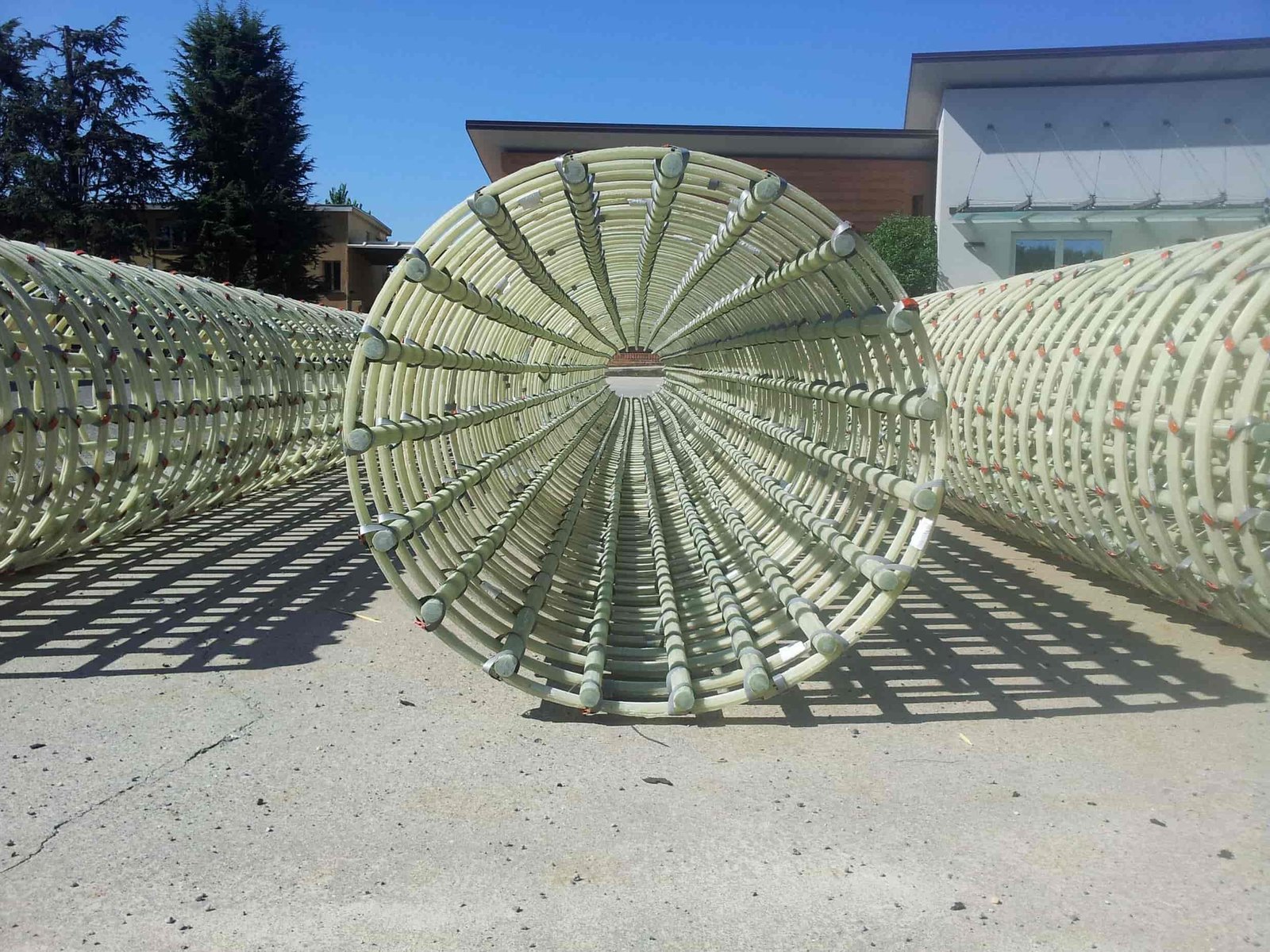
GFRP stands for Glass Fiber Reinforced Polymer rebar and represents a composite type of material that, in the present time, has been finding its suitable replacement in the conventional steel rebars used in concrete infrastructure. In this rebar, there are glass fibers embedded in a polymer matrix to create a strong and resistant-to-corrosion material.
How is GFRP Rebar Manufactured?
Glass melting and then drawing into thin strands are included in fiber preparation. The production of glass fibers involves the melting of glass to a molten stage and its drawing at this stage into very fine strands.
The resin used here is normally a polymer, like polyester or epoxy, combined with a hardener to provide a liquid resin.
Glass fibers are now impregnated with the applied resin, ensuring full coverage of the fiber.
Impregnated fibers are cured; most often, in a heated mold, the resin gets solidified to finally form the GFRP rebar.
Advantages of GFRP Rebar
Corrosion Resistance:
GFRP rebar has excellent resistance to corrosion, particularly in application areas where steel rebars would easily experience rust and deterioration.
Lightweight:
GFRP rebar is considerably lighter than steel rebar; thus, lighter structural weights may reduce transportation costs.
High Strength-to-Weight Ratio:
While lightweight, GFRP rebar will also provide very good strength that can be used in applications that are considered demanding.
Non-Conductive:
GFRP rebar is non-conductive, hence suitable for areas where electrical interference is an issue.
Low Maintenance:
GFRP rebar does not rust or corrode and, therefore, requires low maintenance compared to steel rebar.
Application of GFRP Rebar
GFRP rebar finds wide application in construction projects ranging from:
Infrastructure: Bridges, tunnels, and parking garages
Marine Structures: Piers, docks, and offshore platforms
Industrial Facilities: Chemical plants, wastewater treatment plants, and power stations These types are used for the foundations, columns, and beams of residential and commercial buildings.
Conclusion
C Cube Constructions recognizes that GFRP rebar has already emerged as a very strong contender to substitute the conventional type of steel rebar with advantages including corrosion resistance, light weight, and lower maintenance. With further technological advancement, GFRP rebar will be applied innovatively even more in the construction industry.